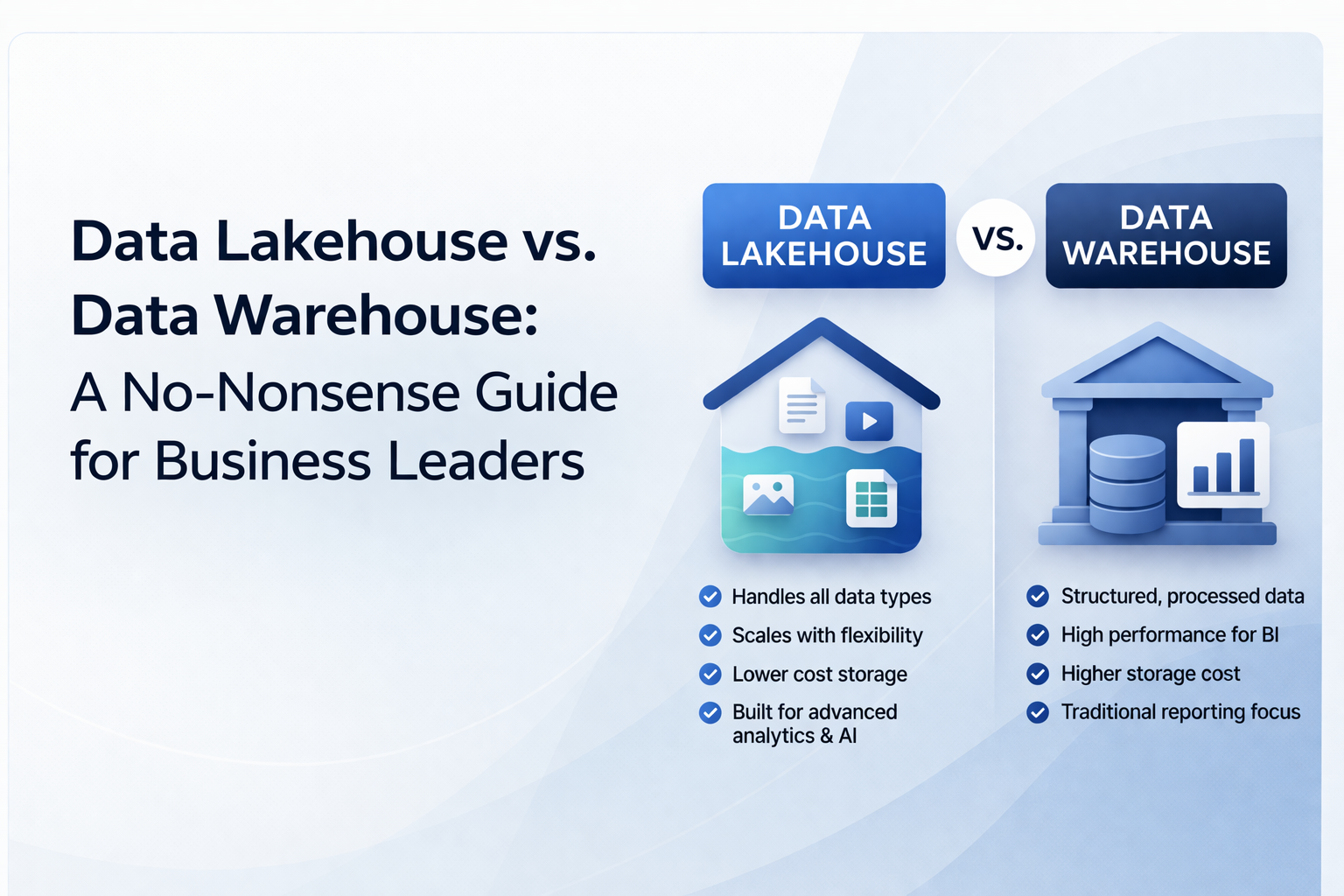
A familiar moment for many leadership teams is reconciling the financial report and the sales dashboard report, not to mention that operations have a third view that also looks right. While all teams are working hard, decision-making is slowing because the data foundation isn’t consistent. This is why the question of data lakehouse vs data warehouse is a leadership decision about speed, trust, governance, and readiness for modern analytics and AI.
What is a Data Warehouse?
A data warehouse is a structured repository built for business intelligence and reporting. Data is cleaned, transformed, and modelled before it is stored in the warehouse. The objective is reliability: consistent metrics, fast SQL performance, and predictable dashboards. Warehouses work best when:
- Data is mostly structured (tables, transactions, CRM/ERP records)
- There are standardised KPIs
- The need for recurring reporting cycles (monthly close, board packs, regulatory reporting)
What is a Data Lakehouse?
A data lakehouse is designed to unify the flexibility of a data lake with the governance and performance patterns of a warehouse. It supports both structured and unstructured data and is built for modern analytics workloads, including machine learning, streaming, and experimentation. Lakehouses work best with:
- Structured reporting and AI/ML readiness
- Multiple data types (tables + logs + documents + IoT streams)
- A single location for engineers, analysts, and data scientists to collaborate
Data Lakehouse Vs Data Warehouse: Key Differences;
Understanding data lakehouse vs data warehouse differences help businesses choose between reliable BI reporting and flexible, AI-ready analytics platforms.
| Primary purpose | Trusted BI reporting and KPI consistency | Unified analytics for BI + AI/ML + streaming |
| Schema approach | Schema-on-write (define structure before loading) | Schema-on-read and schema-on-write (flexible + governed) |
| Best for data types | Mostly structured data | Structured, semi-structured, and unstructured data |
| Speed & performance | Very strong for SQL dashboards and high concurrency | Strong, but depends on modelling and optimisation choices |
| Data prep | Heavier upfront ETL/ELT standardisation | Can ingest raw first, then refine progressively |
| AI/ML readiness | Often requires exporting data for ML pipelines | Built to support ML workflows closer to the data |
| Real-time analytics | Often batch-first; real-time can be an add-on | Designed to support streaming + near real-time patterns |
| Governance needs | Strong governance on curated datasets | Governance must cover raw + curated + AI assets (broader scope) |
| Cost drivers | Compute + storage is often higher for fully curated structures | Storage can be cheaper; compute usage needs active FinOps control |
| Operational complexity | Can be simpler for pure BI use cases | Can simplify the overall stack by reducing duplication across lake + warehouse |
| Typical outcomes | Reliable reporting, consistent dashboards | Reliable reporting plus faster experimentation and AI readiness |
👉 Need Help Evaluating Data Lakehouse vs Data Warehouse Differences For Your Use Case?
Why Does this Conversation Matter for Leaders Now?
AI and Copilots often require diverse data (documents, logs, events, customer interactions). Real-time expectations are rising: leaders want operational insight faster, not weeks later. Trust and governance matter more because decisions are faster and more automated. Open and flexible architecture matters because businesses don’t want to rebuild everything every time priorities change.
The question remains: how to achieve warehouse-level trust without sacrificing lake-level flexibility. That’s where the lakehouse model typically enters the discussion. When is a data warehouse the best choice?
- Finance and leadership reporting is the core problem
- KPIs are stable and auditable (close process and compliance reporting)
- Data sources are structured and predictable (ERP/CRM/transaction systems)
- Teams want faster wins with less architectural change
A typical warehouse supports a single revenue view across the business. It ensures faster board reporting cycles with fewer manual reconciliations
When is a Data Lakehouse the Best Choice?
A lakehouse is a strong fit when you need analytics, AI, and scale in a single, governed environment. It suits best with the:
- Integration of many systems and formats (SaaS + APIs + logs + files)
- Avoiding duplicating data into separate platforms for BI vs ML
- Flexibility to evolve models as the business changes
- Experimentation without breaking governance
A typical lakehouse accelerates the onboarding of new data sources, reduces duplication, and lowers the number of “shadow datasets”. It paves the way for real-time and AI workloads.
How Can Business Leaders Decide?
When evaluating lakehouse vs warehouse for BI, organisations must balance performance for dashboards with flexibility for advanced analytics.
1) Start with the Decision you can’t Afford to Get Wrong
Ask: What decision causes the most damage when data is inconsistent?
Examples include risk and compliance reporting, margin and profitability views, cash flow forecasting, and production or supply chain visibility.
If your biggest risk is inconsistent metrics and reporting, the warehouse path may deliver faster stability. If your biggest risk is falling behind on AI and modern analytics, a lakehouse strategy may be the stronger foundation.
2) Assess your Data Reality, Not Your Ideal State:
Leaders often assume their data is mostly structured. Critical context resides in items such as support tickets, documents and contracts, machine logs, CRM notes, chat/email signals, and IoT or operational telemetry.
If these are central decision-making matters, a lakehouse is usually better aligned.
3) Decide Based on Governance Maturity
Governance isn’t a checkbox. It’s how consistently your organisation can answer questions like who owns this dataset? Who can access it? Where did this number come from? And what changed since last month?
If you need strict reporting controls now, a warehouse can be simpler. If you need governance across multiple data types and AI use cases, a lakehouse approach can be more future-ready, but it requires the right operating discipline.
4) Look at the Total Cost through “Duplication”
Many businesses pay the hidden tax of multiple copies of the same data, multiple transformation pipelines, mismatched KPI definitions and teams building parallel “mini warehouses”.
If your stack is duplicating effort, the lakehouse model often reduces long-term complexity—as long as it’s implemented with strong standards and cost controls.
5) Choose your “Next 12 Months,” not just “Next 12 Weeks”:
A good decision doesn’t only solve today’s dashboard problem. It sets you up for faster integration of new sources, better data quality processes, AI readiness without panic migrations and most importantly, sustainable reporting governance.
For many leaders, a balanced approach is to start with a warehouse-style model to stabilise reporting, then expand into lakehouse capabilities as they scale and adopt AI/ML.
Choose Kloudify for Critical Data Storage Solutions:
Kloudify helps leaders make the Data lakehouse vs. Data warehouse decision based on outcomes, then implement it without turning the business into an IT project.
Where teams typically struggle is not the tooling. It’s the execution layer: data modelling choices, governance design, security boundaries, and aligning reporting and engineering teams on a single definition of truth.
With Kloudify, you get support across the full data lifecycle, including:
- Architecture and roadmap aligned to business goals (reporting reliability, AI readiness, scale)
- Data integration and modelling so KPIs don’t fragment across departments
- Governance and security design (access control, lineage thinking, consistent standards)
- Analytics delivery with executive-ready reporting that stays consistent as systems grow
A practical, phased rollout approach that prioritises visible wins without locking you into a fragile design.
A data warehouse stores structured data for consistent reporting and BI dashboards, while a data lakehouse combines structured and unstructured data to support both analytics and AI workloads in a unified platform. .
A business should choose a data lakehouse when it needs to handle multiple data types, enable machine learning, support real-time analytics, and reduce data duplication across systems.
A data warehouse is the better option when organisations need highly reliable reporting, stable KPIs, structured data management, and strong governance for compliance and financial reporting.
[Inference] In many cases, a data lakehouse can reduce the need for separate data warehouses by supporting both reporting and advanced analytics. However, some organisations still use both depending on governance and legacy requirements.
Yes, a data lakehouse is generally better suited for AI and machine learning because it allows access to diverse data types and supports processing closer to where the data is stored. .