The penetration of Artificial Intelligence has disrupted traditional business models and paved the way for AI-powered business solutions. AI and ML can enhance customer experiences, streamline operations, and drive innovation, provided advanced storage architectures power them. Implementing disaggregated storage enables greater flexibility and allows scaling of storage and compute independently to maximise resource utilisation. Businesses that fail to implement a suitable architecture to integrate AI& ML workloads risk falling behind in an increasingly data-driven world.
What is AI & ML Infrastructure?
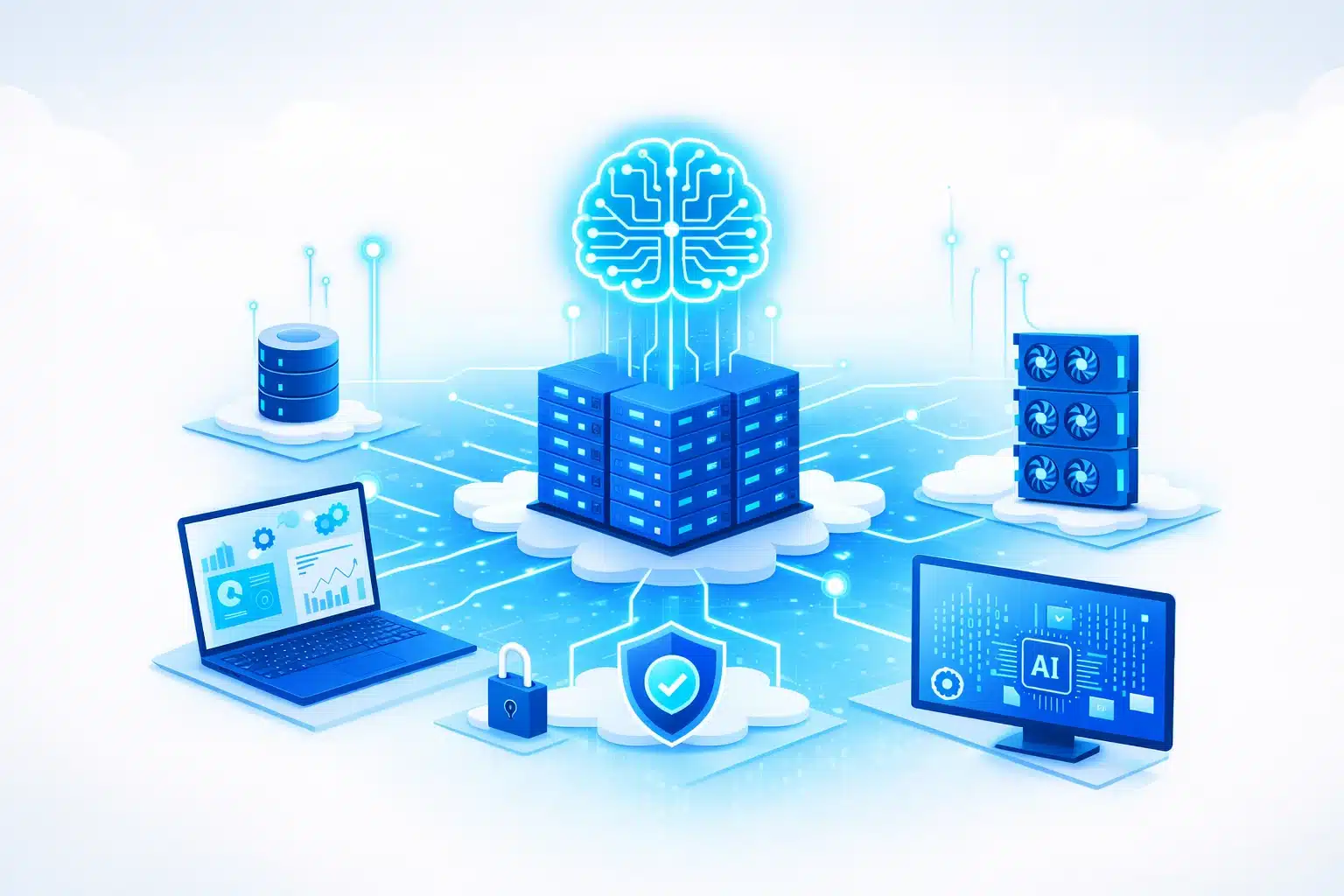
The foundational framework that actively supports the development, deployment, and management of artificial intelligence solutions is called the AI & ML infrastructure. It comprises the hardware, software and networking components required to process large volumes of data, train machine learning models and deploy AI applications. With a robust AI infrastructure, businesses can effortlessly handle complex computational tasks, storage requirements, and data flows essential for AI workflows.
How Does it Differ from the Traditional IT Infrastructure?
AI applications differ fundamentally from traditional apps in how they process data and utilise compute resources. Conventional IT systems are not designed to handle the unique demands of AI and ML workloads.
AI demands custom infrastructure with massive computational power, as AI workloads consume and generate huge data volumes, often in real-time. Training deep learning models (LLMs) that power generative AI applications involves parameters and complex mathematical operations.
The requirements for generative AI demand specialised high-throughput processors, scalable and fast-access storage, low-latency memory access, and high-bandwidth networking capabilities. It must enable all core components of an AI application at every stage of the AI pipeline, ensuring optimal performance, scalability, and responsiveness throughout the process.
Agentic systems proactively take action without human involvement; therefore, to support them, advanced orchestration and real-time decision-making capabilities are essential. They incorporate dedicated software, including machine learning libraries and frameworks, which are critical for developing, training, and deploying AI models. These tools are not commonly found in traditional IT stacks, which are more focused on day-to-day enterprise applications and data management.
Key Components of AI Infrastructure:
| Component | Key Highlights |
| Powerful Computing Resources | High-performance GPUs, CPUs, and TPUs provide the power necessary to train large-scale AI models and execute complex algorithms efficiently. |
| Storage Solutions | Scalable, high-speed storage systems manage large AI datasets, model checkpoints, and intermediate results to ensure quick data access and scalability. |
| Optimised Networking | High-bandwidth, low-latency networks enable fast data transfer and communication for distributed AI workloads and real-time applications. |
| AI-Ready Operating Systems | Pre-configured environments with CUDA and Docker streamline setup, reducing time spent on driver configuration and dependency management. |
| Security & Compliance | Safeguards AI data and models with encryption, access controls, and compliance with global and Australian regulations for secure deployment. |
| Data Processing Resources | Automates data preparation, cleaning, and transformation to enhance AI model accuracy and performance. |
| Machine Learning Frameworks | Simplifies AI model design, training, deployment, and monitoring through automated MLOps platforms. |
| Integrated AI Infrastructure | Combines compute, storage, software, and security into a unified ecosystem for scalable, efficient AI development and deployment. |
How to Build a Robust AI Infrastructure?
Define Budget and Objectives Clearly:
Identify the business problems you intend to solve, the success metrics, and the scale of deployment using AI. Set a realistic budget with available resources. This clarity sets the ball rolling for your entire AI infrastructure plan.
Choose the Right Resources:
Select computing hardware, such as GPUs or TPUs, that are specifically designed for your AI workloads. Select the appropriate machine learning frameworks, data libraries, and software applications, considering factors such as cost, scalability, compatibility, and vendor support.
Implement Security and Compliance Standards:
The AI infrastructure has to comply with regulations related to data privacy and security. Develop policies to protect sensitive data, secure model training processes, and adhere to ethical AI guidelines.
Cloud vs. On-Premises Deployment:
Do you want to build AI infrastructure on cloud platforms like AWS, Azure, or IBM Cloud or deploy on-premises? Cloud offers flexibility and pay-as-you-go pricing, while on-premises may provide tighter control and faster processing for specific workloads. Hybrid approaches blending both are fast gaining popularity.
Networking Solutions:
Select networking technologies like high-bandwidth 5G networks that ensure low latency and reliable connections across data storage, processing units, and users. Private network options offer added security.
Manage, Monitor, and Always Maintain the Infrastructure:
Regularly update software, conduct diagnostics, review workflows, and audit security policies to ensure optimal performance and compliance. Effective maintenance extends system durability and ensures consistent AI service quality.
Benefits:
Accelerated Performance and Speed:
AI ecosystems use parallel processing, which dramatically reduces the time required to train ML models. Speed is crucial in many AI applications, such as high-frequency trading and autonomous vehicle systems. Advancements in speed and performance are an essential component of AI architecture.
Security & Compliance
A robust AI infrastructure ensures that privacy regulations are correctly adhered to when managing and processing data during the development of new AI applications. AI infrastructure solutions adhere to all applicable laws and standards on compliance, ensuring the preservation of user data and safeguarding businesses against legal and reputational harm.
Collaboration:
Strong AI infrastructure also provides developers and engineers with the techniques and processes they need to collaborate more effectively while developing AI applications. AI systems utilise MLOps methods, which are a lifecycle for AI development designed to expedite and automate ML model building, enabling users to construct, distribute, and manage their AI projects more efficiently.
Reduced Costs:
AI infrastructure optimises resources and uses the finest available technology in the development and implementation of AI initiatives. Investing in robust AI infrastructure yields a higher return on investment for AI efforts than attempting to implement them on obsolete, inefficient IT infrastructure.
Greater Generative AI Capabilities:
Generative AI is a form of artificial intelligence that can generate its own content, such as text, images, videos, and computer code, based on basic human instructions. Generative AI has the potential to boost productivity for businesses and individuals alike significantly. AI infrastructure built on a strong framework for Generative AI can help organisations in developing their capabilities safely and responsibly.
Kloudify helps Australian businesses rapidly harness the power of AI-driven automation through seamless deployment of tools like Azure OpenAI Service, Power Automate AI Builder, Microsoft Copilot Studio and RPA solutions.
Kloudify can help businesses streamline repetitive tasks and enhance decision-making, thereby reducing operational costs. Their expertise enables effective customer engagement through tailored AI automation services that seamlessly integrate with existing tech stacks. Would you like to discuss this further? Reach out rightaway!