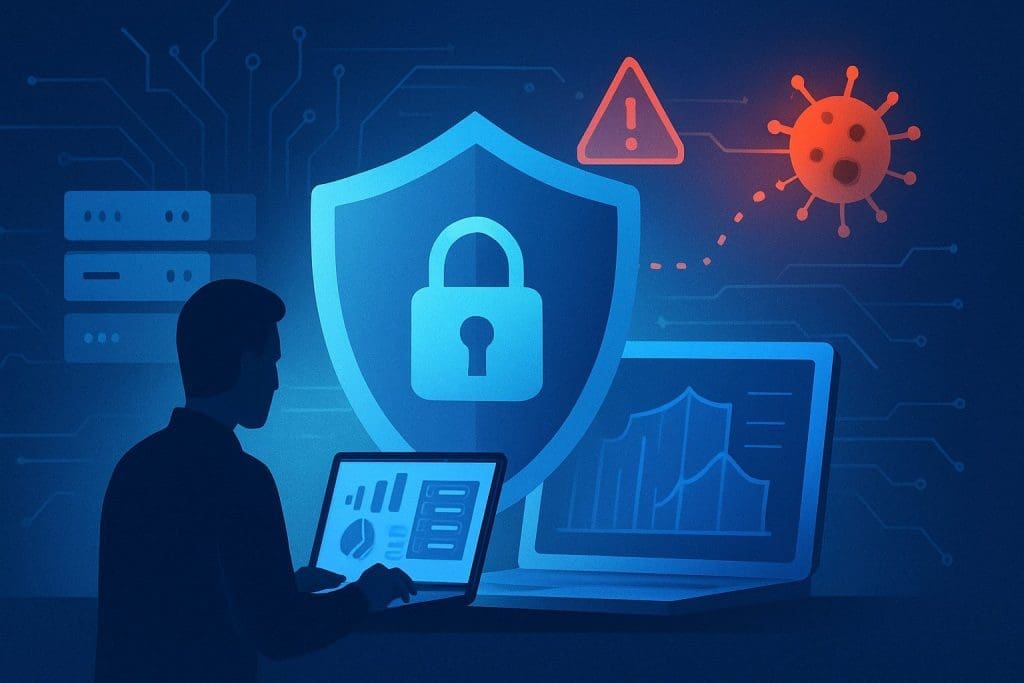
Endpoints are the most vulnerable points in a given attack surface and are also the most challenging IT assets to handle. Securing endpoints prevents cybersecurity attackers from leveraging them to cause collateral damage to the IT infrastructure and applications. With the rise of remote workforces, cloud adoption, and advanced persistent threats (APTs), Zero Trust has become a cornerstone of modern cybersecurity strategies.
The underlying core principle behind Zero Trust endpoint security is that all users and devices, whether inside or outside the network, must be verified before access is granted.
What is Zero-Trust Endpoint Security Management?
Zero Trust endpoint security management establishes a comprehensive security architecture for the infrastructure by integrating endpoint security with network security. It enables users to leverage intelligence gained from endpoints to set firewall policies that isolate specific endpoints in the event of any security incident.
Zero Trust endpoint security also combines VPN (Virtual Private Network) security, allowing your security policy to follow the user and endpoint globally, protecting endpoints regardless of their location. The Zero Trust model works on:
- Identity verification that ensures every user/device claim.
- Least privilege access that grants only the necessary access for tasks.
- Micro-segmentation of networks into smaller, isolated segments to limit lateral movement.
- Continuous monitoring of activities in real time to detect threats.
- Zero Day defence to overcome the risks of assumption-based protection strategies that trust everything unless it has explicitly been identified as dangerous.
Key Principles of Zero Trust in Endpoint Security:
The traditional security model, which relies on the concept of a trusted perimeter, is less effective for advanced cloud computing and remote work policies. The Zero Trust model focuses on verifying every user and device before granting access to the resources. The following are key principles of Zero Trust applied in endpoint security.
Verification Above Trust:
Every request to connect to the business network or access sensitive information is verified, regardless of the user/device location. These requests are carried out using methods such as multi-factor authentication (MFA), while also leveraging factors including user identity, device health, and contextual data.
Least Privilege Access:
This principle grants a minimum level of access to users and devices, enabling them to perform their tasks effectively. You monitor users and devices constantly to identify and optimise over-privileged identities, allowing you to limit the potential for a breach or security incident.
Always Assume Breach:
Develop a robust and thoroughly tested incident response plan so that when endpoint attacks do occur, teams can respond promptly. This plan also helps organisations shrink the target and impact zone of an attack through networking principles, such as micro-segmentation. This is discussed next.
Micro-Segmentation:
Divide the network into smaller segments to isolate potential security breaches and limit the damage that can occur. It constrains the cybersecurity attacker’s lateral movement within the network to help contain the damage by preventing unchecked navigation.
Automated Context Analysis:
Zero Trust architecture uses automated systems to gather context around user behaviour and endpoint health security. The context data helps make informed decisions about access permissions and enables prompt responses to any suspicious activity across endpoints.
Best Practices To Implement Zero Trust Endpoint Security:
The successful implementation of Zero Trust in endpoint security requires a systematic approach. Note the following table for more clarity:
| Practice | Benefits |
| Security Posture Assessment | Identify critical network points, such as servers, workstations, and mobile devices, vulnerable to attack. Understand your current security setup and architecture. Detect weaknesses and monitor for unusual or suspicious activity. Ensure visibility and verification of every access request (core Zero Trust principle). |
| Zero Trust Implementation Roadmap | Shift from network-focused to identity-focused security. Plan assessment, implementation, and monitoring steps. |
| IAM and Micro-Segmentation | Verify every user’s identity and limit access based on roles (least privilege). Use multi-factor authentication to strengthen security. Use micro-segmentation to isolate important assets and prevent attackers from moving freely within a network. |
| Enterprise Integration | Adopt or upgrade tools that support Zero Trust. Use endpoint protection and detection tools for real-time security. |
| Cross-Functional Collaboration | Involve IT, security, legal, and compliance teams. Train users to adapt smoothly to Zero Trust processes. |
| AI Patch Management | Automate patching of all devices to reduce vulnerabilities quickly. Saves time and resources versus manual patching. |
Reach out for a free consultation on your security posture now.
Choose Kloudify as your Security Partner:
Several organisations are adopting multi-cloud environments and implementing remote work policies, increasing risks at the endpoints. In Zero Trust security, as reiterated throughout, all users and devices, whether inside or outside the network, are continuously verified and validated. Applying Zero Trust security principles to endpoints not only increases visibility into user behaviour and devices but also enables businesses to detect anomalies in real-time.
Kloudify is a certified Microsoft partner specialising in Microsoft-backed security solutions that safeguard your business from evolving cyber threats.
With deep expertise in endpoint protection, threat detection, and Zero Trust implementation, Kloudify ensures every device, user, and connection is always secure, anywhere. Built for scalability and compliance, Kloudify’s tailored approach strengthens your business’s security posture while maintaining efficient operations and driving growth. Let us discuss.