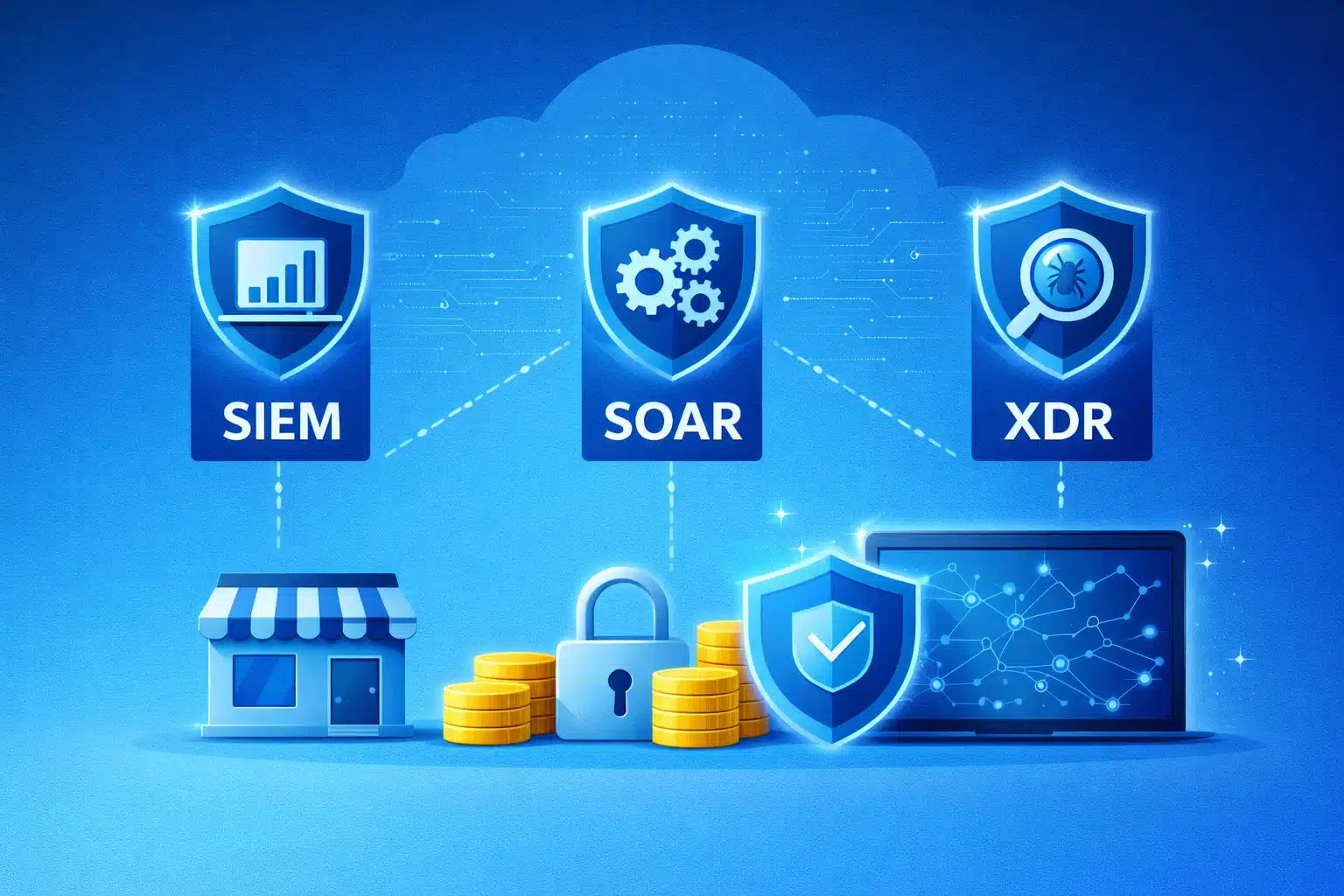
Businesses today face more email and collaboration security threats than ever before and are compelled to confront them with increasingly short-staffed cybersecurity teams. Cybersecurity for small businesses relies on effective tools to identify and respond to security threats and to proactively prevent future incidents. Tools like SIEM vs SOAR vs XDR are often discussed as essential security measures but understanding how they differ and when to use each can be challenging.
Understanding XDR, SIEM, and SOAR
Let’s take a closer look at XDR, SIEM, and SOAR tools to understand how they differ and see how they can complement each other.
Three Tools. Three Approaches. One Smart Security Decision. Choose the Right Security Model Before Threats Choose You.
What is XDR?
Extended Detection and Response (XDR) is the next-generation upgrade to endpoint detection and response (EDR) for devices such as laptops and phones. XDR integrates insights from email, networks, cloud workloads, and identity systems, providing a panoramic view that helps security teams spot real threats faster, reduce false alarms, and respond more effectively across the entire IT landscape.
It takes a holistic approach to threat detection and response, streamlining security data ingestion, analysis, and prevention and remediation workflows across the security stack. XDR can automate even complex, multi-step responses across their security technology stacks.
What are its functions?
- Collect, correlate, and analyse data from endpoints, cloud workloads, networks, and email using advanced automation and AI.
- Prioritise data and deliver insights to security teams in a normalised format through a single console.
- Coordinate and consolidate siloed security tools to unify and streamline security analysis, investigation, and remediation.
- May include access to experienced experts in threat hunting, threat intelligence and analytics when purchased as a managed solution
- Improved threat visibility, accelerates security operations, reduces TCO and eases the ever-present security staffing burden.
What is SIEM?
Security information and event management (SIEM) collects logs from antivirus, intrusion detection, and other security systems. Its built-in analytics are basic, but ML-powered add-ons can profile normal user/device behaviour to flag oddities.
Users may often need multiple SIEM tools to achieve comprehensive threat coverage. Security information and event management (SIEM). This combines security event management (SEM) and security information management (SIM) capabilities to enable analysts to review log and event data, understand and prepare for threats, and retrieve and report on log data. What are its functions?
- Collects log data from across the business and uses it to spot, classify, and analyse security events and incidents.
- Highlights malicious activity by extracting information from all parts of the environment, including network apps and hardware.
- Unifies everything on a single platform for easier monitoring and investigation.
- Uses this data to trigger alerts, generate reports, and support fast, informed incident response.
What is SOAR?
Security Orchestration, Automation, and Response (SOAR) is a suite of tools that automates threat remediation and triages complex incidents, reducing manual effort and streamlining security workflows. It pulls data from diverse sources such as SIEMs and threat intelligence platforms, excels at rapid response orchestration, and operates independently or as a SIEM enhancer, prioritising action over logging. SIEM helps organisations detect potential security threats before they disrupt business operations.
What are its functions?
- Gathers threat intel, automates routine responses, and triages complex threats to reduce human involvement.
- Combines threat/vulnerability management, incident response, and ops automation into one powerhouse for a stronger, smoother security setup.
- Blends manual expertise, human oversight, and machine learning to sift security data and prioritise responses.
- Ultimately boosts team efficiency and accelerates threat handling by automating data collection and response.
XDR vs. SIEM vs. SOAR: Key Differences
XDR, SIEM, and SOAR are cybersecurity tools that analyse and respond to security events. The difference lies in how each toolset approaches the problem. The easiest way to understand these differences is to compare them:
| Feature | SIEM | SOAR | XDR |
| Primary Focus | Log management, event correlation, and compliance reporting. | Incident response automation, workflow orchestration, and efficiency. | Cross-layered threat detection, unified investigation, automated response. |
| Data Sources | Wide IT logs/events from the entire environment. | Alerts/data from integrated tools/threat feeds. | Deep telemetry from endpoints, network, cloud, email, and identity. |
| Automation | Limited (rule-based alerts). | Extensive (playbooks, multi-tool workflows). | Built-in detection/response in the ecosystem. |
| Detection Method | Rule-based correlation, anomaly detection. | Enriches alerts (not primary detection). | AI/ML, behavioural analytics, root cause analysis. |
| Response | Alerting/reporting. | Orchestrated actions, human/automated. | Automated containment/remediation. |
| Primary Goal | Visibility, compliance, threat ID. | SOC efficiency reduces MTTR. | Handle advanced threats with fewer blind spots. |
| Strengths | Comprehensive data storage and audit trails. | Cuts manual work, standardises processes. | Prioritises high-risk events and rapid response. |
| Limitations | Data overload, slow analytics without add-ons. | No native detection, connectivity-dependent. | Vendor-specific scope, less broad logging. |
| Integration | Feeds many tools, but one-way often. | Bi-directional with SIEM/tools. | Native within the stack, expands via APIs. |
| Scalability | Handles massive log volumes but is resource-intensive. | Scales with playbooks/tools. | Optimises for priority events. |
| Typical Cost | High (storage/processing). | Medium (automation focus). | Variable (endpoint/cloud heavy). |
How can SMBs Choose Between XDR, SIEM and SOAR?
XDR is ideal for organisations that require a unified platform for threat detection and response. It is suitable for businesses that require visibility across multiple security layers and want to automate the threat response.
SIEM is well-suited for large organisations with complex infrastructure that require capabilities such as log management, compliance reporting, and detailed visibility into network activity. If your concern is tracking events and keeping logs to meet compliance requirements, SIEM is the best choice.
Finally, SOAR is for organisations facing an overwhelming number of security alerts that require automation to execute repetitive tasks and orchestrate applications. It is best suited for security operation teams looking to improve efficiency and reduce manual work.
As businesses grow, it’s important to consider tools built on an open architecture, such as a hybrid XDR solution. Since open architecture doesn’t rely solely on proprietary technology, it is possible to integrate XDR, SIEM, and SOAR tools to leverage the data they need to offer the best protection against today’s cybersecurity challenges.
Are you puzzled about how to get started? Reach out to cybersecurity experts in Australia for a free consult – Kloudify.