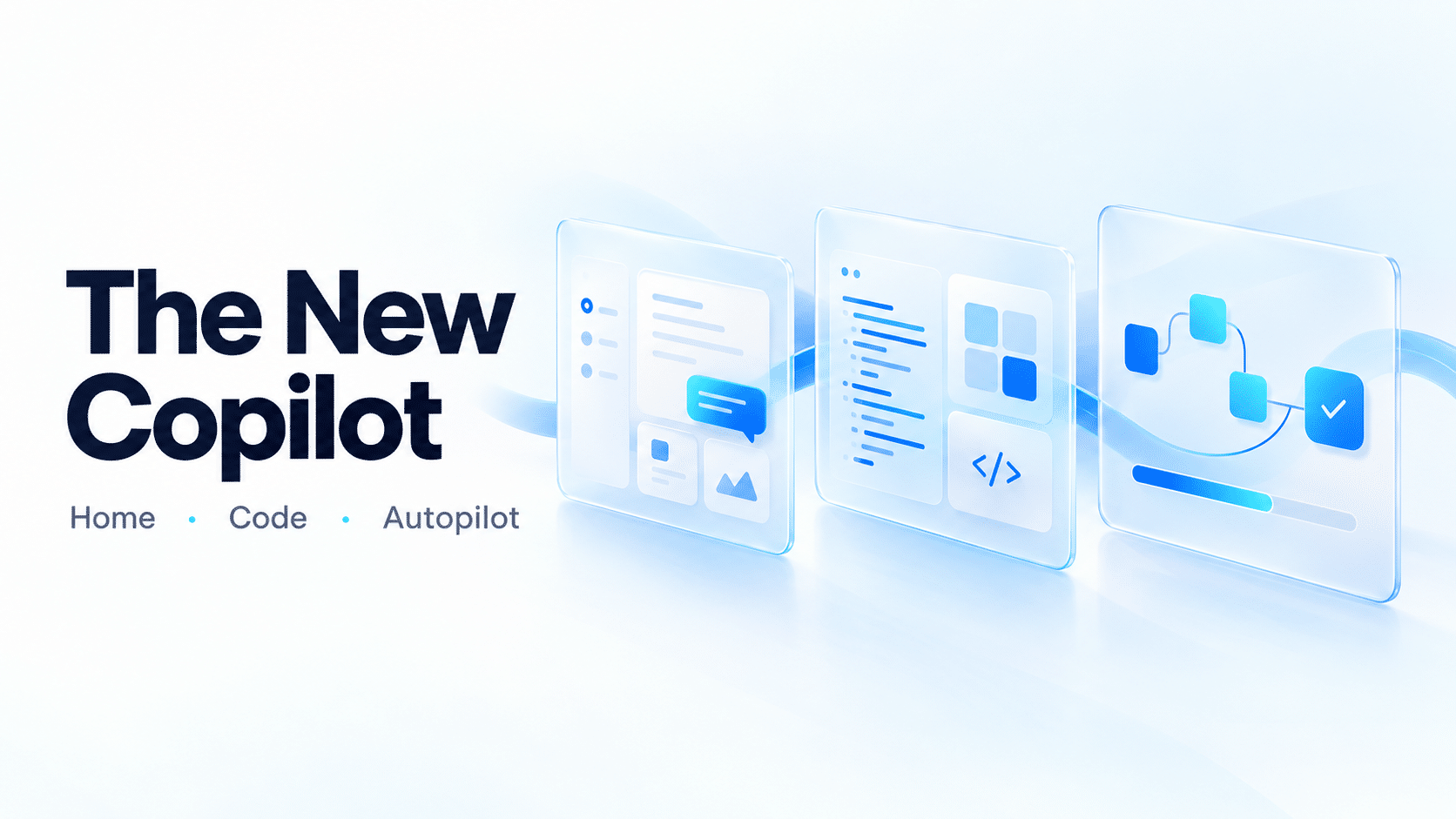
Microsoft has announced the next evolution of Microsoft Copilot, introducing three major new capabilities designed to transform how organisations work with AI: Home, Code, and Autopilot. According to Microsoft, these new experiences will gradually roll out through the Copilot Frontier programme, with broader availability to follow.
What’s New?
Home: A New Starting Point for Work
Home brings together Copilot Chat and Cowork into a single experience, allowing users to quickly access conversations, recent activity, suggestions, documents and tasks from one location. Microsoft is also integrating the full capabilities of Word, Excel and PowerPoint directly into Copilot, enabling users to create and edit real Office documents without switching between applications
Code: Build Solutions Using Natural Language
Code extends Copilot beyond content creation and into application development. Users can describe dashboards, automations, workflows or business applications in plain English, and Copilot will generate the solution. Microsoft states that Code is powered by the same underlying technology as GitHub Copilot and can be securely hosted within an organisation’s Microsoft 365 tenant.
Autopilot: Your AI Digital Colleague
Perhaps the most significant announcement is Autopilot. Unlike traditional assistants that only respond to prompts, Autopilot can operate continuously in the background, managing recurring processes, following up on actions, monitoring conversations and progressing work even when users are offline. Microsoft describes it as a persistent digital teammate with its own workspace, memory and identity within your Microsoft 365 environment.
A Change in How Copilot May Be Billed
Alongside these new capabilities, Microsoft has outlined a more flexible AI consumption model.
For core productivity scenarios, users will continue to be licensed through the familiar User Subscription Licence (USL) model, which includes Copilot capabilities across Chat, Word, Excel, PowerPoint, Outlook and Teams.
However, Microsoft has also introduced a Usage-Based Billing (UBB) model for advanced AI workloads.
According to Microsoft, new agentic capabilities such as Cowork, Code and Autopilot will consume usage-based credits rather than being fully covered under the standard user licence.
In other words:
- Standard Copilot usage remains covered by your per-user Copilot licence.
- Advanced autonomous AI experiences may incur consumption-based charges.
- Organisations will have greater flexibility but will also need governance and spend controls to avoid unexpected costs.
What This Means for Customers
As Microsoft expands Copilot’s capabilities, many organisations are asking an important question:
Do we want all users automatically consuming new AI services that may attract usage charges?
The answer will depend on your organisation’s AI strategy, governance framework and budget allocation.
For some businesses, enabling these advanced capabilities will unlock substantial productivity gains. For others, it may be prudent to implement controls and establish usage policies before broader adoption.
Microsoft has also announced new FinOps for AI capabilities, providing administrators with tools to:
- Monitor AI consumption
- Establish spending policies
- Control which AI models are available to users
- Track credit usage and balances
- Optimise AI investment outcomes
Kloudify’s Recommendation
As these new Copilot capabilities become available, we recommend organisations:
✅ Review current Copilot licensing and AI governance policies.
✅ Assess whether usage-based AI services align with budget and business objectives.
✅ Understand which new capabilities are included in existing licences and which may incur additional costs.
✅ Consider disabling or restricting consumption-based services until governance controls are in place.
✅ Monitor Microsoft announcements closely as licensing and consumption models continue to evolve.
Need Help?
The Copilot landscape is changing quickly, and many organisations are looking for guidance around licensing, governance, security and cost management.
The Kloudify team can help you:
- Assess your Copilot readiness
- Review licensing implications
- Implement AI governance frameworks
- Configure controls for usage-based AI services
- Maximise ROI from Microsoft 365 Copilot
Partner with Microsoft experts you can trust
If you’d like to understand how these new Copilot capabilities may affect your organisation, contact the Kloudify team for a tailored assessment.