What begins as a few well-designed dashboards for a single team often expands rapidly across departments. New workspaces appear, datasets are duplicated, KPIs are redefined, and reports are shared widely without validation. Over time, confidence in analytics declines not because the data is wrong, but because no one is certain which version is right.
This is where Power BI governance becomes critical.
Governance is not about slowing down innovation. It is about creating a structured foundation that enables analytics to scale without introducing inconsistency, risk, or compliance exposure. When implemented correctly, governance ensures that Power BI becomes more reliable as adoption grows, rather than becoming more fragile.
What is Power BI Governance?
At its core, data governance in Power BI extends beyond policies into operational clarity. Power BI governance is the structured system of ownership, standards, and controls that ensures analytics remain accurate, secure, and scalable.
It defines how datasets are created, how reports move into production, how security is applied, how performance is monitored, and how compliance requirements are met. Most importantly, it ensures that analytics scale without losing clarity. Power BI governance answers essential operational questions such as:
- Who owns this dataset?
- Has this KPI definition been approved?
- What will be impacted if this column changes?
- Who has access to sensitive data?
- Is this report certified for executive use?
If these questions require investigation rather than immediate clarity, governance maturity needs improvement.
Kloudify approaches governance not as documentation, but as an operating model embedded into daily reporting workflows.

Not sure if your Power BI Environment is Governed or Growing into Risk?
Get a quick governance assessment from Kloudify
Why Does Power BI Governance Break Down at Scale?
In growing organisations, teams build what they need to solve immediate reporting problems. With time, this decentralised growth introduces friction.
This is where enterprise Power BI governance becomes essential.
Issues include
- Multiple datasets built from identical source systems
- Different departments calculating the same KPI differently
- Reports published directly to production environments
- Row-level security implemented inconsistently
- No structured approval process before executive distribution
- Refresh failures discovered too late
These are governance gaps, and without structure, even powerful tools create confusion. A well-defined governance framework addresses these gaps proactively rather than reactively.
The Structure of a Strong Power BI Governance Framework
A mature framework is not a checklist of Power BI governance best practices, but a system that balances control with agility. It connects ownership, lifecycle, security, and reliability into a repeatable operating model.
A mature Power BI governance structure includes the following core pillars:
| Pillar | What it Governs | Outcome |
| Ownership & Accountability | Dataset and reporting responsibility | Clearly assigned owners and stewards |
| Lifecycle & Standards | Development and deployment discipline | DEV → TEST → PROD release structure |
| Security & Compliance | Controlled data access | RLS, OLS, sensitivity labels |
| Operational Reliability | Monitoring and refresh discipline | Defined SLAs and alerting |
| Trust & Reuse | Dataset certification and standardisation | Single source of truth across domains |
These pillars work together to prevent duplication, protect sensitive data, and ensure that reporting assets remain reliable over time.
Kloudify helps organisations implement these pillars, ensuring that governance becomes a sustainable system rather than a one-time initiative.
Governance Roles that Create Accountability:
Governance only works when responsibility is clearly defined. This is where the Power BI governance operating model plays a role.
| Role | Primary Responsibility | How does Governance Help? |
| Data Owner | Data accuracy and access decisions | Maintains KPI integrity |
| Data Steward | Definitions and metadata | Ensures consistency |
| BI Developer | Model design and DAX standards | Prevents duplication |
| Power BI Admin | Tenant and workspace control | Maintains security posture |
| Governance Council / CoE | Oversight and enforcement | Aligns strategy and policy |
This structure prevents fragmentation and ensures that dataset quality and access controls are not left unmanaged.
Semantic Model Governance: Building Trust
Most governance failures originate at the dataset layer. When semantic models are built inconsistently or duplicated across teams, KPI drift becomes inevitable. A dataset-first governance strategy treats semantic models as enterprise assets rather than report-specific builds. Check the following table that matches governance controls with business outcomes:
| Governance control | Business outcome |
| Certified datasets | Reduced metric disputes |
| Standard DAX definitions | Maintainable models |
| Documentation | Faster onboarding |
| Dataset reuse policies | Lower duplication |
| SLA monitoring | Consistent reliability |
Extended Governance
Security within Power BI must extend beyond simple workspace permissions. Mature governance integrates layered controls across the environment. Key security elements include:
- Azure Active Directory group alignment
- Row-Level Security (RLS)
- Object-Level Security (OLS)
- Sensitivity labels
- Export and sharing policies
- Tenant-level configuration standards
In regulated environments, including Power BI for government use cases, these controls are not optional. They are essential for maintaining compliance, audit readiness, and data protection.
Lifecycle Governance: Structured Release Management:
A governed Power BI environment treats reporting as an enterprise application lifecycle rather than ad-hoc publishing. The lifecycle typically includes:
- Development workspace
- Testing and validation stage
- Controlled production release
- Formal change approval
- Impact analysis prior to structural changes
- Release documentation
| Stage | Governance Objective |
| DEV | Safe experimentation |
| TEST | Validation and security review |
| PROD | Certified distribution |
| MONITOR | Ongoing reliability checks |
Operational Governance: Sustaining Performance Over Time
Governance does not end after implementation. It must be operationalised. Sustained governance includes:
- Refresh monitoring and alerts
- Quarterly sprawl reviews
- Capacity and performance tracking
- Security audits
- KPI alignment workshops
- Adoption measurement
- Without operational oversight, governance gradually weakens.
Kloudify builds monitoring dashboards and governance cadences that enable organisations to continuously measure governance effectiveness.
Warning Signs of Weak Power BI Governance:
Governance gaps often appear gradually. By the time they become visible, trust is already declining.
Common indicators include:
- leadership questioning which report is correct
- repeated rebuilding of similar datasets
- inability to trace KPI definitions quickly
- unexpected exposure of sensitive data
- frequent refresh or performance failures
These are not isolated issues. They are signals that governance structure is missing or incomplete.
If these warning signs sound familiar, it’s time to move from reactive reporting to structured governance. Kloudify can help you design that shift.
Kloudify’s Structured Governance Implementation Approach:
Kloudify approaches Power BI governance as a strategic capability not a documentation exercise. Instead of isolated fixes, governance is implemented through a structured progression:
- Assessment to evaluate tenant health, duplication, and risk
- Blueprint design to define roles, standards, and architecture
- Foundation setup to align workspaces, datasets, and security
- Lifecycle enablement through deployment pipelines and change control
- Operationalisation via monitoring, governance cadence, and CoE
This ensures governance becomes embedded in how reporting is built, deployed, and maintained.
Governance Enables Sustainable Power BI Growth
Power BI governance is the dividing line between scalable analytics and reporting chaos.
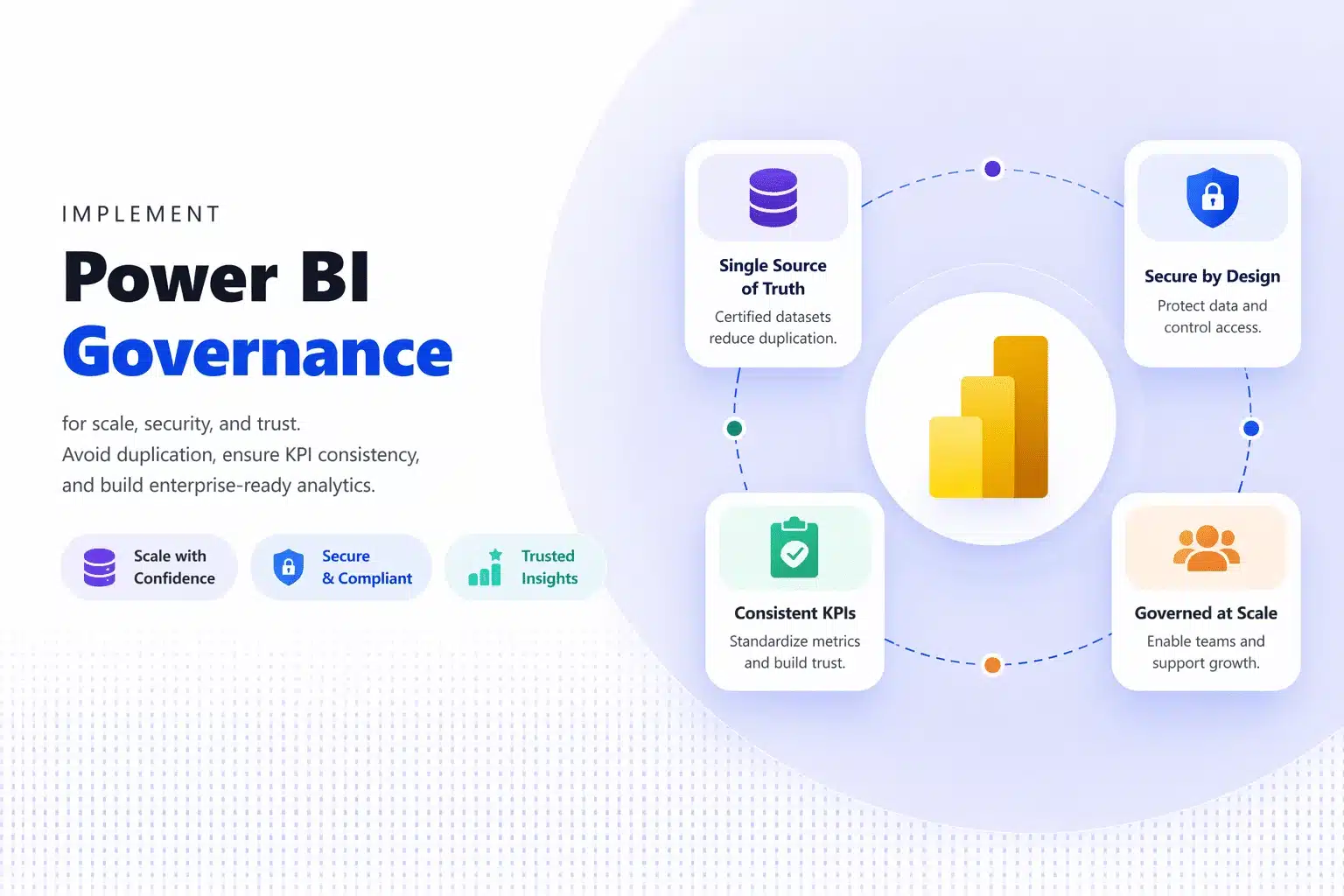
Without it, duplication increases, trust declines, and compliance risk rises. With it, organisations achieve trusted single sources of truth, secure and controlled sharing, and predictable operational performance.
Kloudify helps organisations implement Power BI in a clear, structured, governed, secure manner built to scale. If your Power BI environment is expanding and you are beginning to see duplication, inconsistency, or access concerns, it may be time to formalise governance before complexity compounds.