Hybrid Cloud Vs Multi Cloud – How Do You Choose the Right Cloud Strategy?
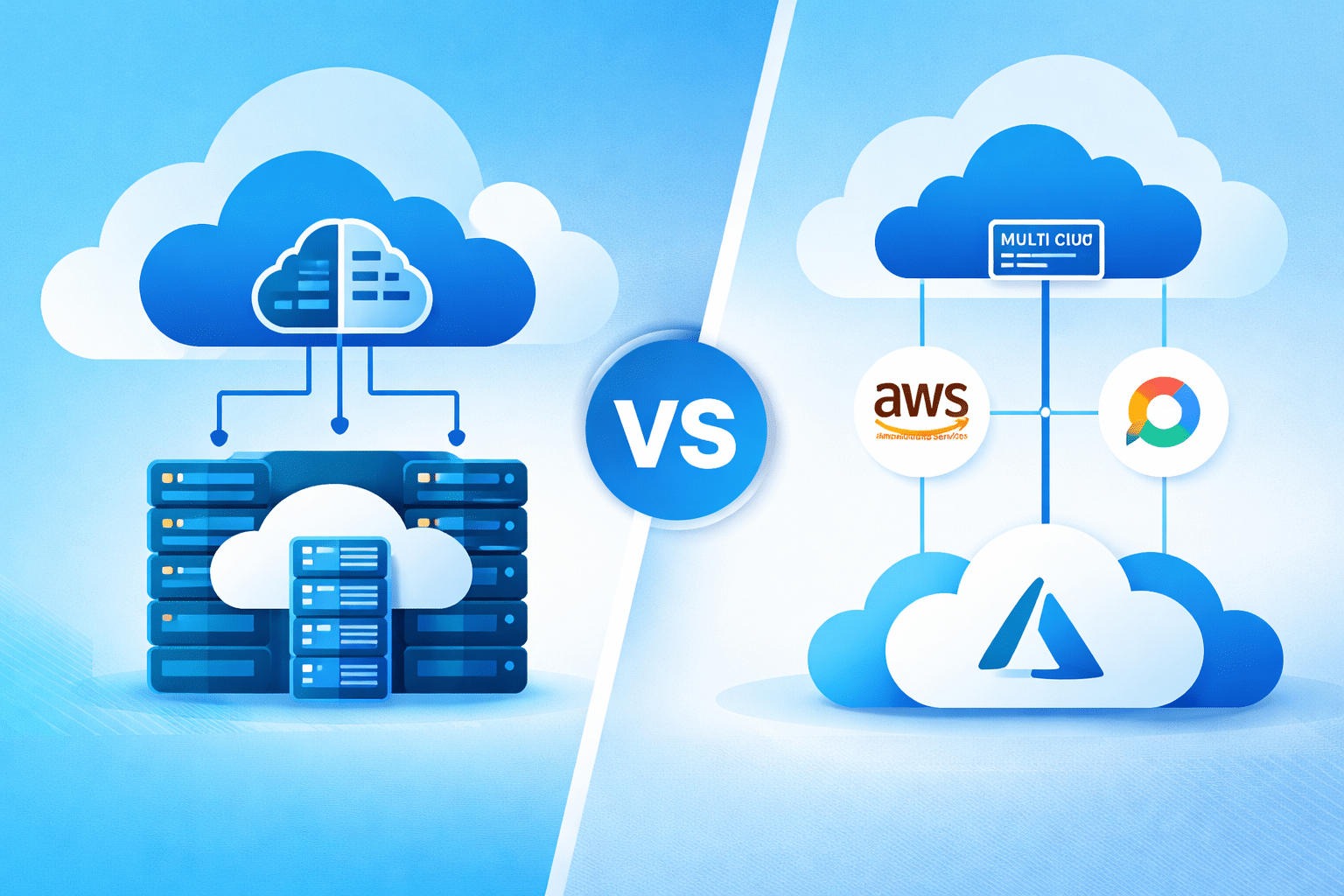
The focus for businesses that target growth and scalability shifted to engineering cloud environments for maximum strategic impact. In this context, two cloud approaches have gained traction: multi-cloud and hybrid cloud. Both these strategies represent distinct features that enable control, flexibility, and resilience in a fast-changing technology landscape. We will now discuss Hybrid Cloud Vs Multi-Cloud in detail.
What is a Multi-Cloud Environment?
Multi-cloud refers to an enterprise IT strategy that leverages cloud services from multiple public cloud providers. This means running workloads across Amazon Web Services (AWS), Microsoft Azure, and Google Cloud Platform (GCP), picked for their strengths. The objective here is not to connect to a private data centre or a single vendor but to choose the best-in-class service from different vendors for specific jobs. Exploring Multi cloud vs Hybrid cloud is the first step in this direction.
What is a Hybrid Cloud Environment?
A hybrid cloud combines on-premises infrastructure, such as enterprise data centres or private clouds, with public cloud services. This architecture enables organisations to extend their data centre capacity, use public clouds for specific workloads, and maintain centralised management across both. A hybrid cloud strategy is defined by the combination of a private cloud (your own on-premise data centre) and at least one public cloud. These two environments must be seamlessly integrated, allowing data and applications to move between them.
Hybrid Cloud Vs Multi Cloud
| Feature | Hybrid Cloud | Multi-Cloud |
| Architecture | Combines on-premises infrastructure with cloud services, allowing sensitive data to stay on-site while utilising scalable cloud resources. | Uses multiple independent cloud providers, each operating separately, offering flexibility but requiring more management for interoperability. |
| Cloud Provider | Primarily relies on one main cloud provider alongside on-premises workloads, balancing security, performance, and scalability. | Employs multiple cloud providers (e.g., AWS, Azure, Google Cloud) for specific needs to reduce vendor dependency and optimise services. |
| Integration | Requires strong integration between on-premises and cloud systems to ensure seamless data and application movement. | Limited integration between clouds, as each platform operates independently, increases flexibility but complicates unified management. |
| Security & Compliance | Easier to secure sensitive data on-site while applying cloud security policies; requires careful coordination across environments. | Security varies by provider; requires consistent policies and uniform management across all platforms to maintain compliance and protection. |
| Deployment Flexibility | Enables running workloads on both local and cloud environments, allowing organisations to choose based on security, cost, or performance needs. | High flexibility to deploy across different cloud services from various vendors, allowing customisation but adding complexity in management. |
| Objective | Integrate on-premises and public cloud to balance control and scalability. | Use best of services across multiple public clouds to meet specific business requirements. |
| Key benefit | Maintains control over sensitive data and supports gradual migration to the cloud. | Avoids vendor lock-in and leverages specialised services for diverse workload optimisation. |
| When to Choose | Suitable if you have existing IT infrastructure, strict data compliance requirements, or prefer phased cloud adoption. | Ideal when needing to reduce dependence on a single vendor and requiring diverse cloud-native services across workloads. |
| Suitable sectors | Specific benefits | |
| Hybrid Cloud | The healthcare, finance, and government sectors have strict data privacy and regulatory requirements. | Keeps sensitive data on-premises while leveraging cloud scalability and flexibility for less sensitive, high-volume workloads. |
| Multi-Cloud | Large enterprises, global organisations, e-commerce, and media industries. | Prevents vendor lock-in, improves performance, and reduces downtime by leveraging the strengths of multiple cloud platforms. |
Hybrid Cloud vs Multi Cloud- Which is Better for Businesses?
Multi-cloud environments make sense for:
- Enterprises seeking vendor diversity to reduce business risk.
- Those businesses that want cutting-edge services such as AI, ML, and advanced analytics.
- Multinational companies requiring a globally distributed cloud presence.
Hybrid Cloud is a better fit for:
- Enterprises are subject to stringent regulatory requirements preventing full public cloud adoption.
- Companies heavily invested in legacy IT systems that demand a phased shift.
- Workloads demanding ultra-low latency, such as manufacturing process control.
Here is a middle path. Enterprises are adopting hybrid multi-cloud approaches that combine the best of both worlds in the following manner:
- Core systems and sensitive workloads stay on-premises.
- Multi-cloud strategies distribute less sensitive workloads across public clouds.
- Unified management platforms (e.g., Kubernetes, Anthos, Azure Arc) simplify setting up across environments.
Let us also look at the challenges of both now.
Hybrid Cloud Vs Multi Cloud – Challenges
| Challenge | Hybrid -Cloud | Multi-Cloud |
| Integration | Connecting private systems with public clouds can be tricky and may cause problems with improper planning | Managing different cloud platforms with their own tools and settings can be complicated. |
| Security | Need to maintain consistent security across both private and public systems to mitigate risks. | Hard to keep security uniform across many providers; always needs monitoring |
| Responsibility | Unclear who handles what, which can slow down fixing issues. | Shared responsibilities between many providers and teams can make accountability difficult. |
| Operations | Moderate effort mainly around integration. | A lot of effort to manage many platforms, tools, and billing systems. |
| Governance | Easier, but it needs unified policies across private and cloud environments. | Constant checks are needed to ensure compliance with rules across all cloud providers. |
| Cost | Costs are more predictable with a single leading cloud provider and an on-premises setup. | Costs can vary widely and may include hidden fees if not managed. |
| Skills | Needs skills for hybrid setups, but less complex than multi-cloud. | Requires experts to manage multiple complex clouds, which is hard to find. |
How Do Businesses Make a Choice?
The multi-cloud vs. hybrid cloud decision ultimately depends on the business strategy that influences the choice of technology. The balance between innovation speed and regulatory Compliance, and operational agility with cost predictability, is a must.
Multi-cloud may deliver best-of-breed services and global reach, but it introduces management complexity. Hybrid cloud preserves control and Compliance but requires ongoing investment in legacy systems. The ideal strategy should leverage both approaches, maximising flexibility without sacrificing control. Further:
Assess workload requirements to identify applications that require strict data storage, fast response times, or support for older systems. Hybrid cloud is suited to regulated or critical tasks. Multi-cloud is for when you need access to different cloud features or more flexibility.
If you require strict rules for data handling, a hybrid cloud makes control simpler. Multi-cloud, on the other hand, needs strong policies to maintain consistent standards across providers.
Hybrid setups often require higher spending for private systems. Multi-cloud offers flexibility but needs close cost tracking to avoid additional costs.
Hybrid cloud requires a capable in-house team to manage systems. Multi-cloud requires advanced skills to handle multiple platforms.
In a future defined by AI, edge computing, and sustainability, devising a cloud strategy will become the competitive edge for businesses. Partner with Kloudify, a leading Microsoft services provider in Australia, to get started.